Independent comparison service. Not affiliated with or endorsed by the Musée du Louvre.

How long will your Louvre visit take?

Choose your time, select the artworks you want to see, and get an optimised stop order with a realistic duration — based on local Louvre collection data, not averages.

Artwork locations last synced: 2026-07-24T09:53:30.149827+00:00

A · Paintings · Denon · Salle 711

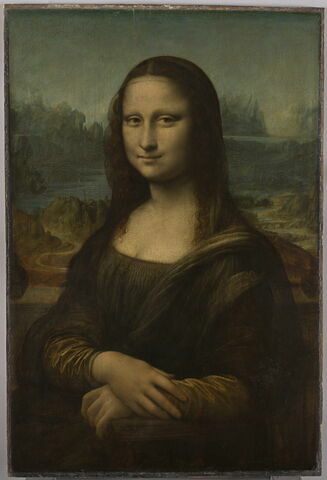
Mona Lisa

Leonardo da Vinci

© 2018 GrandPalaisRmn (musée du Louvre) / Michel Urtado

Why it matters / what to look for

Why it matters. Leonardo turned a formal court portrait into the illusion of a living encounter. The turning body, direct gaze and ambiguous smile give the sitter a psychological presence that reshaped European portraiture.

  • The face: The outlines around the eyes and mouth seem to dissolve. Leonardo built them from extremely thin translucent layers—the technique known as sfumato, which softens transitions between light and shadow.
  • The pose: The figure is not strictly frontal. Her upper body turns toward you, making the formal pose feel like the end of a natural movement.
  • The hands: Resting one over the other on the chair arm, they anchor the sitter in the foreground and reinforce her composure.
  • The landscape: Far behind her, roads, water and mountains gradually lose their sharpness, creating atmospheric depth.

Good to know. Probably begun around 1503, the portrait stayed with Leonardo for years; he continued refining it, took it to France and left it unfinished at his death.
A · Ancient sculpture · Sully · Salle 345

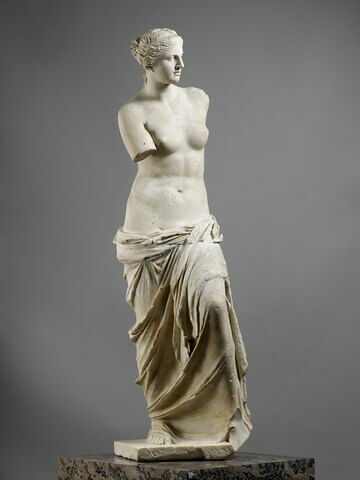
Venus de Milo

Ancient Greece

© 2011 Musée du Louvre, Dist. GrandPalaisRmn / Thierry Ollivier

Why it matters / what to look for

Why it matters. Two separately carved sections of Parian marble meet at the hips, where bare flesh gives way to heavy drapery. That contrast makes the incomplete figure feel both poised and in motion.

  • The hips: Follow the joint around the middle: the statue was made in two main pieces, and the drapery helps conceal their meeting point.
  • The drapery: Notice how the mantle gathers over one leg and drops toward the base, setting its deep folds against the smooth torso.
  • The missing attachments: Look for small fixing holes once used for separate bronze ornaments, including a diadem and a bracelet.

Good to know. Discovered on Melos in 1820, the statue reached the Louvre in 1821; its arms, left foot and several other parts were already missing.

A · Ancient sculpture · Denon · Salle 703

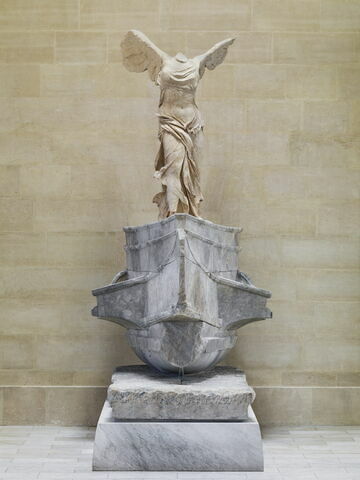
Winged Victory of Samothrace

Hellenistic art

© 2014 Musée du Louvre, Dist. GrandPalaisRmn / Philippe Fuzeau

Why it matters / what to look for

Why it matters. The monument joins a winged goddess carved in Parian marble to a ship’s prow built from Lartos marble blocks. Separate materials and parts combine into one forceful forward movement.

  • The left wing: Follow the surviving feathers outward and upward. The spread wing enlarges the silhouette and makes the goddess appear to meet the air around her.
  • The drapery: Across the torso and legs, thin clinging folds alternate with deeper windblown ridges, making the stone register both body and movement.
  • The prow: Step back to see the goddess and ship-shaped base together. Sixteen blocks form the prow beneath the statue rather than a neutral pedestal.

Good to know. Found in the Sanctuary of the Great Gods on Samothrace in 1863, the monument was assembled from many surviving fragments and restored again in 2014.

A · Paintings · Denon · Salle 711

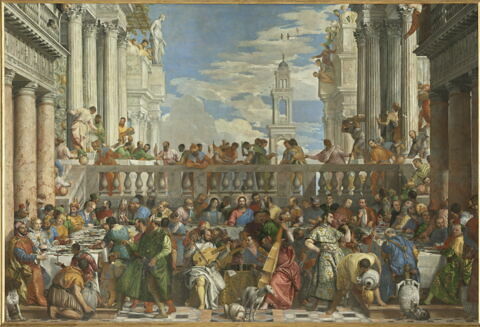
The Wedding at Cana

Paolo Veronese

© 2019 GrandPalaisRmn (musée du Louvre) / Michel Urtado

Why it matters / what to look for

Why it matters. Veronese set a biblical miracle inside a lavish Venetian feast and filled a canvas nearly ten metres wide with some 130 guests. It is the largest painting in the Louvre, and it turns a sacred story into worldly Renaissance spectacle.

  • Christ at the centre: Amid the noise, Christ sits still and frontal at the middle of the long table, the calm axis of the whole crowded scene.
  • The musicians: In the foreground a group of musicians plays; by tradition they are portraits of Venetian painters, Veronese himself among them.
  • The miracle: Look to the lower right, where servants pour out the water that has just become wine, the actual miracle pushed to the edge of the party.

Good to know. Painted in 1562-1563 for the refectory of the San Giorgio Maggiore monastery in Venice, the canvas was seized by French troops in 1797 and brought to the Louvre in 1798.

A · Paintings · Denon · Salle 700

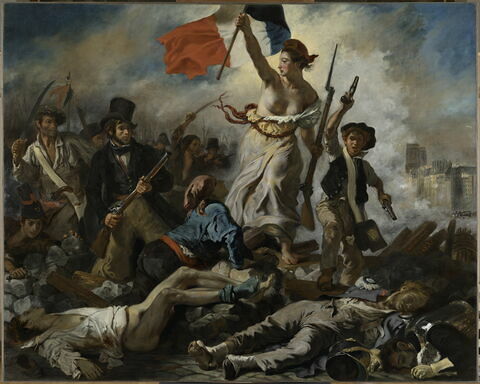
Liberty Leading the People

Eugène Delacroix

© 2024 GrandPalaisRmn (musée du Louvre) / Rabeau/Didierjean

Why it matters / what to look for

Why it matters. Delacroix turned a real, very recent uprising, the July Revolution of 1830, into an allegory. A bare-breasted Liberty carries the tricolour over a barricade, welding living political events to a timeless personification.

  • Liberty and the flag: At the centre, Liberty strides forward holding the tricolour flag in one hand and a bayonetted musket in the other, part woman and part symbol.
  • The barricade: Below her, the dead and the paving stones of a barricade form the base she climbs, mixing raw violence with heroic uplift.
  • The distant towers: Far right, through the gunsmoke, the towers of Notre-Dame place the action firmly in the streets of Paris.

Good to know. Painted from September to December 1830, the canvas was shown at the Salon of 1831 under the title The 28th of July: Liberty Leading the People.

A · Paintings · Denon · Salle 700

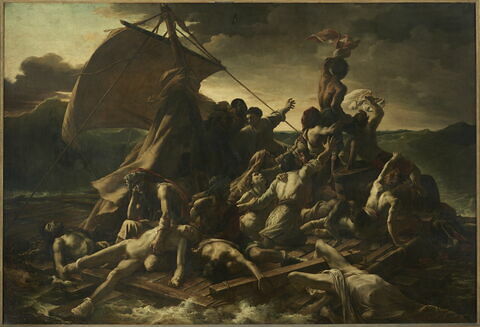
The Raft of the Medusa

Théodore Géricault

© 2015 GrandPalaisRmn (musée du Louvre) / Michel Urtado

Why it matters / what to look for

Why it matters. Géricault painted a recent naval disaster at the scale of grand history painting, nearly five metres by seven. Showing the dead and dying of a real, politically charged shipwreck, rather than myth, was radical for the 1819 Salon.

  • The raft: The survivors ride a platform lashed together from the frigate’s own wreckage; notice how fragile and overloaded it looks.
  • The survivors: Of the 150 people who crowded onto the raft, only fifteen were alive after twelve days adrift; that toll fills the heap of figures.
  • The horizon: Far off, a tiny sail marks the brig Argus, which finally sighted the raft; that faint shape is the survivors’ one chance of rescue.

Good to know. Géricault never sold the painting in his lifetime; the French state bought it in 1824, at the sale after his death, and it has hung in the Louvre since 1826.

A · Paintings · Denon · Salle 702

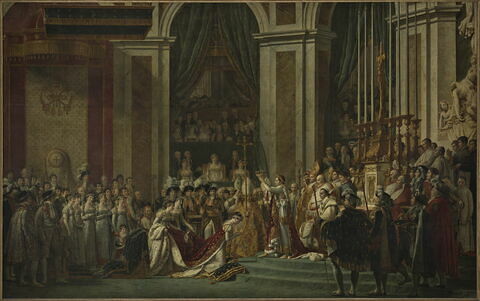
The Coronation of Napoleon

Jacques-Louis David

© 2018 GrandPalaisRmn (musée du Louvre) / Michel Urtado

Why it matters / what to look for

Why it matters. David transformed a modern state ceremony into a monumental history painting and a collective portrait. Controlled architecture, hierarchy and light focus attention on the imperial couple while recording Napoleon’s new court.

  • The central light: Step back and follow the light falling from the cathedral’s high windows. It isolates Napoleon, Joséphine and the pope from the surrounding crowd.
  • The arranged groups: Compare the dense banks of clergy, diplomats, officials and family around the open foreground. David reorganized the real ceremony to establish a clear hierarchy.
  • Napoleon’s mother: High in the central gallery sits Laetitia Bonaparte, although she was actually in Rome. Her inclusion turns an absence into an image of dynastic unity.
  • David himself: In a gallery, the painter appears drawing among relatives and fellow artists, presenting himself as both witness and author of the official image.

Good to know. After seeing the nearly finished canvas in 1808, Napoleon requested one change: David raised the pope’s arm so that he visibly blessed the ceremony.

A · Paintings · Denon · Salle 702

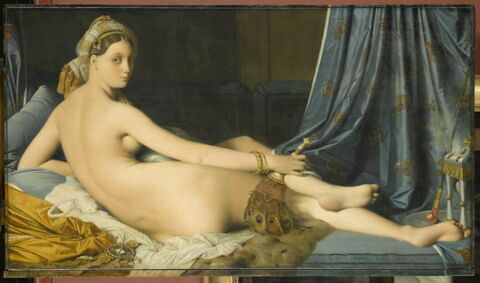
La Grande Odalisque

Jean-Auguste-Dominique Ingres

© 2017 GrandPalaisRmn (musée du Louvre) / Franck Raux

Why it matters / what to look for

Why it matters. Ingres builds the reclining figure from a long turn of back, face and folded leg, then frames her with cool blue fabrics. The tightly controlled arrangement makes a private commission feel deliberately staged.

  • The turn of the body: Follow the figure from her face in three-quarter view along the back to the bent left leg. The pose makes the gaze and body move in opposite directions.
  • The peacock fan: At the lower right of the figure, her hand holds a peacock-feather fan against the folded leg, concentrating texture and colour in one small area.
  • The blue setting: Compare the blue bed, cushions and right-hand curtain with the white and brown disordered sheets that support the nude.

Good to know. Painted in 1814 for Caroline Murat, queen of Naples, the work was not publicly presented at the Salon until 1819.

A · Sculpture · Denon · Salle 403

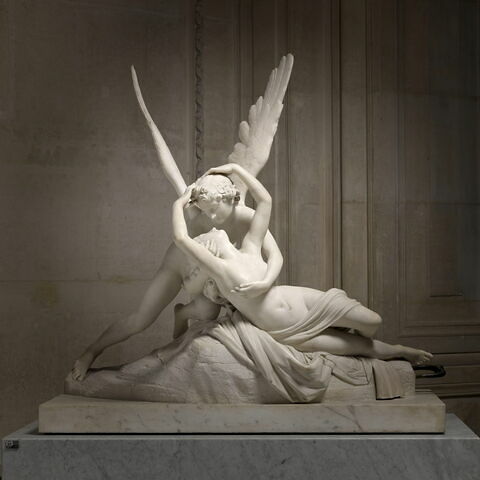
Psyche Revived by Cupid's Kiss

Antonio Canova

© 2011 GrandPalaisRmn (musée du Louvre) / René-Gabriel Ojéda

Why it matters / what to look for

Why it matters. Canova froze the instant Cupid's kiss wakes Psyche from a deathlike sleep. Two bodies cross in a light, rising diagonal, and the polished marble seems to breathe, a defining work of Neoclassical tenderness.

  • The crossing diagonals: The two figures form an X: Cupid's wings and raised body cross Psyche's arching torso, so the group looks weightless from every side.
  • The circle of arms: Her arms curve up to draw his head down; the two sets of arms close into a gentle ring around the almost-touching faces.
  • Walk around it: Move around the marble; Canova shaped it to give a balanced silhouette from each viewpoint, not a single front.

Good to know. Commissioned by Colonel John Campbell in 1787 but never delivered, the group later passed to Joachim Murat, Napoleon's brother-in-law, and reached the Louvre in 1809.

A · Sculpture · Salle 001

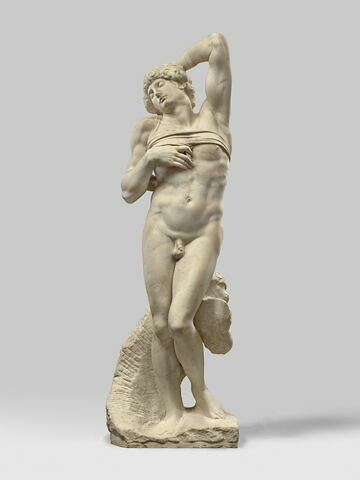
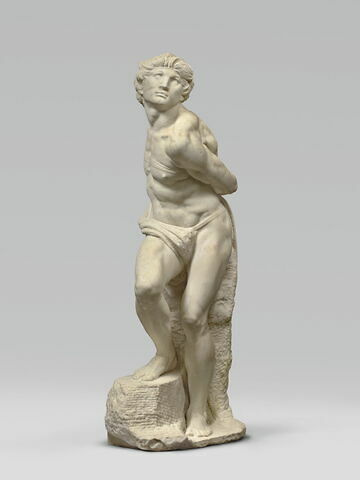
Dying Slave

Michelangelo

© 2022 Musée du Louvre, Dist. GrandPalaisRmn / Hervé Lewandowski

Why it matters / what to look for

Why it matters. Michelangelo carved this young captive for the tomb of Pope Julius II. Caught between sleep, ecstasy and death, the languid nude turned a minor tomb figure into one of sculpture's most sensual studies of the male body.

  • The pose: The body sags and twists as if slipping from consciousness, one arm raised behind the head, somewhere between falling asleep and dying.
  • The unfinished figure: Behind the left leg, a barely worked block of stone roughs out a small figure that Michelangelo left unfinished.
  • Finished versus rough: Compare the highly polished skin with the chisel-marked areas around it, showing how the figure emerges from raw marble.

Good to know. Begun around 1513-1515 for Julius II's tomb but left out of the final, reduced monument, the statue was given by Michelangelo to Roberto Strozzi and passed to the king of France.

A · Egypt · Sully · Salle 635

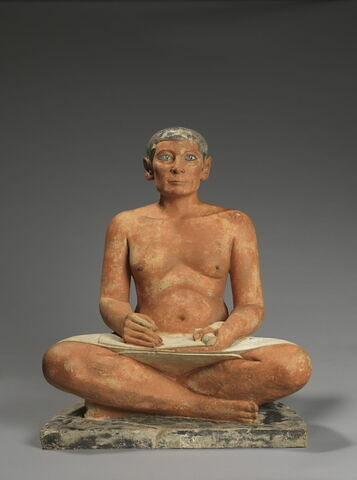
The Seated Scribe

Ancient Egypt

© 2015 Musée du Louvre, Dist. GrandPalaisRmn / Christian Décamps

Why it matters / what to look for

Why it matters. Painted limestone is combined with rock crystal, Egyptian alabaster and copper to make the seated official’s eyes unusually complex. Material precision turns a compact writing pose into an alert presence.

  • The eyes: Move closer to see the rock-crystal irises set into alabaster whites and edged with copper. The layered inlay gives the gaze its sharp focus.
  • The writing pose: The scribe sits cross-legged with a papyrus roll spread across his lap, holding the body in a stable working triangle.
  • The painted surface: Compare the surviving colour on the limestone body with the gleaming eye inlays; the contrast separates living flesh from precise detail.

Good to know. The statue was discovered on 19 November 1850 in a shaft north of the Serapeum at Saqqara and entered the inventory in 1854.

A · Egypt · Sully · Salle 338

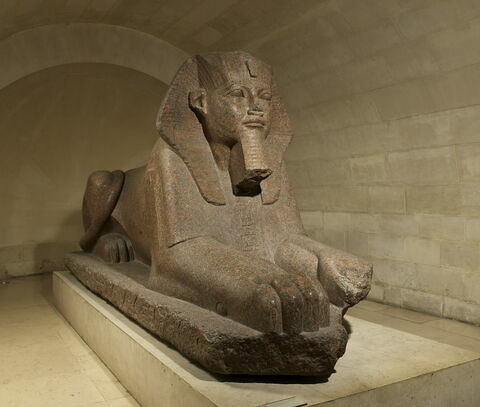
Great Sphinx of Tanis

Ancient Egypt

© 2010 Musée du Louvre, Dist. GrandPalaisRmn / Christian Décamps

Why it matters / what to look for

Why it matters. A royal human head, nemes headdress and uraeus rise from a recumbent lion carved in pink granite. The compact fusion gives royal authority a body that is both watchful and physically powerful.

  • The head: Look at the striped nemes headdress, upright uraeus and straight false beard: each identifies the human face as royal.
  • The lion body: Step back to compare the broad chest and extended forepaws with the smaller human head; the change of scale strengthens the hybrid form.
  • The granite: Follow the pink stone across head and body. Carving the entire hybrid in the same hard material makes the two anatomies read as one.

Good to know. The original date remains disputed: proposals range from the Fourth Dynasty to the reign of Amenemhat II, with later royal reuse also recorded.

A · Near East · Richelieu · Salle 227

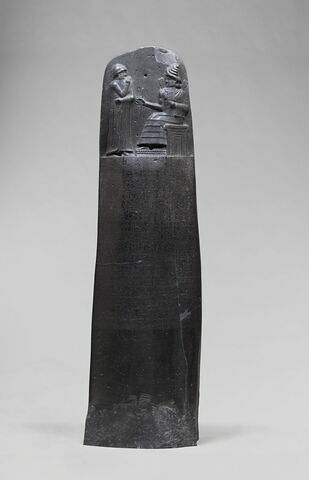
Code of Hammurabi

Babylon

© 2009 GrandPalaisRmn (musée du Louvre) / Franck Raux

Why it matters / what to look for

Why it matters. The basalt stele joins a royal image to an extensive legal inscription. By placing Hammurabi before the sun god Shamash above the text, it presents law as both royal action and divine sanction.

  • The summit: At the top, Shamash sits on a throne and extends the ring and staff toward the standing king, visually legitimizing Hammurabi’s authority.
  • Hammurabi: Notice the king’s raised hand, high-edged cap and robe leaving one shoulder bare; his attentive stance distinguishes him from the enthroned god.
  • The inscription: Move closer to see how tightly the engraved lines cover the dark stone below the relief, turning most of the monument into written law.

Good to know. Created during Hammurabi’s reign in Babylon, the broken stele was excavated at Susa in 1901–02 and came to the Louvre through division after excavation.

A · Near East · Richelieu · Salle 228

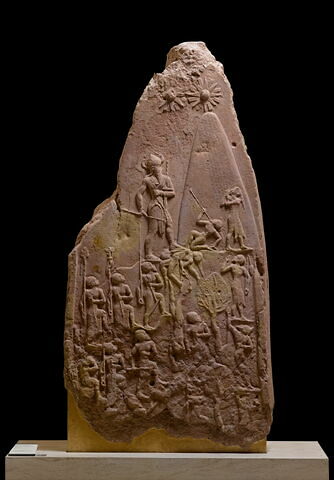
Victory Stele of Naram-Sin

Akkad

© 2009 GrandPalaisRmn (musée du Louvre) / Franck Raux

Why it matters / what to look for

Why it matters. Instead of arranging victory in horizontal registers, the triangular relief drives soldiers and defeated enemies up a wooded mountain toward Naram-Sin. The climb makes military hierarchy part of the landscape.

  • Naram-Sin: Near the summit, the king is larger than every other figure and wears a horned helmet; scale and divine headgear place him above both armies.
  • The ascent: Follow the Akkadian soldiers diagonally upward through the forested mountain. Their repeated weapons and forward steps turn the whole surface into a climb.
  • The defeated: On the right, enemies fall, plead or turn away beneath the advancing king, concentrating the outcome of the battle into a few gestures.
  • The sun disks: Above the mountain, three solar disks occupy the narrow top of the stele, setting the victory beneath a celestial sign.

Good to know. The stele was carried from Sippar to Susa as war booty in the twelfth century BCE, where it was excavated on 6 April 1898.

A · Islamic art

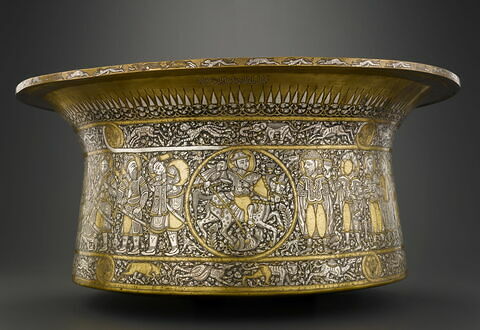
Baptistère of Saint Louis

Mamluk art

© 2009 Musée du Louvre, Dist. GrandPalaisRmn / Hughes Dubois

Why it matters / what to look for

Why it matters. Muhammad ibn al-Zayn combined hammered brass with engraved decoration and re-engraved silver and gold inlay. The basin’s importance lies in this dense, technically layered metal surface rather than precious material alone.

  • The metal ground: Look across the broad brass surface for the shallow marks of engraving, which organize the decoration before any precious inlay is added.
  • The inlay: Move closer and compare the silver and gold set into the brass. Re-engraving adds fine lines within the brighter metal rather than leaving it flat.

Good to know. The Louvre record dates the basin to 1325–40 and gives its place of production cautiously as Egypt or Syria.

B · Paintings · Denon · Salle 710

The Virgin and Child with Saint Anne

Leonardo da Vinci

© 2012 GrandPalaisRmn (musée du Louvre) / René-Gabriel Ojéda

Why it matters / what to look for

Why it matters. Leonardo turns the traditional image of three sacred generations into a fluid family drama. Interlocking bodies and gestures lead toward the lamb, making Christ’s future sacrifice emerge through apparently natural movement.

  • The three figures: Follow the group from Anne’s head through Mary’s shoulder and arm to the Child. Their overlapping bodies form one descending diagonal rather than three separate portraits.
  • The lamb: At the lower right, the Child embraces the sacrificial animal while Mary reaches toward him. A family gesture therefore carries the painting’s central reference to the Passion.
  • The smiles: Compare the three faces: closely related expressions bind the generations together and suggest shared knowledge of the event’s meaning.
  • The landscape: Beyond the figures, layered mountains and water fade into atmospheric distance, while rock strata return close to the foreground.

Good to know. Begun by about 1503 and still unfinished in 1519, the painting stayed with Leonardo for years and was probably acquired by Francis I in 1518.

B · Paintings · Denon · Salle 710

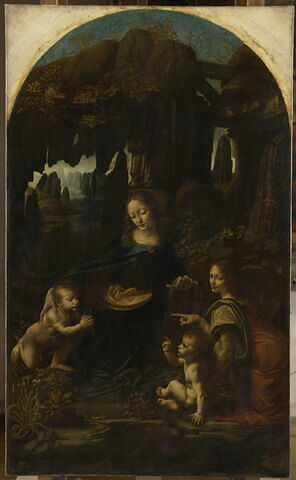
The Virgin of the Rocks

Leonardo da Vinci

© 2018 GrandPalaisRmn (musée du Louvre) / Urtado/Rabeau

Why it matters / what to look for

Why it matters. Leonardo recasts a traditional Adoration as a tightly connected exchange of looks and gestures inside a shadowed grotto. Sacred meaning unfolds through the figures’ relationships and the strange mineral landscape around them.

  • The hands: Mary protects the Christ Child with one open hand and gathers the young Baptist with the other; the angel supports Jesus as he blesses his cousin.
  • The circular group: Follow the figures around the centre rather than across a straight row. Their glances and gestures make the four bodies read as one continuous exchange.
  • The grotto: Dark rock encloses the group while openings reveal mountains and broad water in the distance, linking shelter, wilderness and atmospheric depth.
Good to know. The work originated in a 1483 commission for the Confraternity of the Immaculate Conception in Milan; how this first version later reached France remains unproven.

B · Paintings · Denon · Salle 710

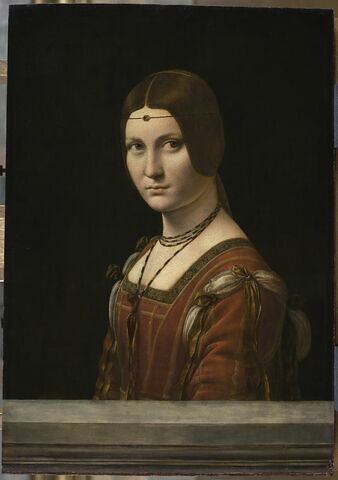
La Belle Ferronnière

Leonardo da Vinci

© 2015 GrandPalaisRmn (musée du Louvre) / Michel Urtado

Why it matters / what to look for

Why it matters. Leonardo replaces the conventional profile with opposing turns of torso and head, giving the sitter physical motion and psychological distance. This alert three-quarter pose helped make the portrait feel strikingly modern.

  • The turn: Her torso angles one way while her head turns back the other, as if something just outside the painting has caught her attention.
  • The eyes: Although the face is almost frontal, the pupils shift slightly upward and to the side, withholding direct contact with the viewer.
  • The dress and hair: The red gown, detachable sleeves, white chemise and silk-and-gold hair net identify the carefully constructed fashion of the late-fifteenth-century Milanese court.

Good to know. The sitter’s identity remains disputed, and the familiar title is itself mistaken: it originally belonged to a different Louvre portrait.

B · Paintings · Denon · Salle 710

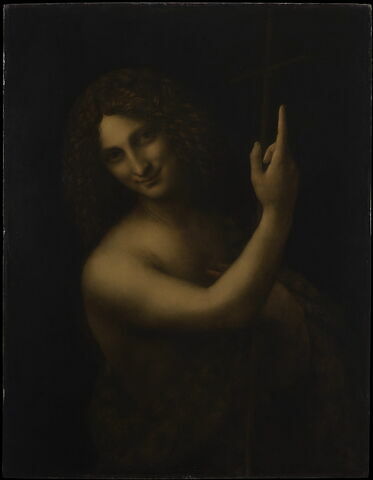
Saint John the Baptist

Leonardo da Vinci

© 2016 GrandPalaisRmn (musée du Louvre) / Tony Querrec

Why it matters / what to look for

Why it matters. Leonardo reduces the image to a turning body, an enigmatic smile and light emerging from darkness. With almost no setting or colour, chiaroscuro itself becomes the means of spiritual revelation.

  • The spiral pose: The torso turns toward the right while the head returns to meet your gaze. The opposing directions make the figure rise like a slow spiral.
  • The hand and face: The bent right arm brings the hand close to the face, concentrating gesture, gaze and smile within a remarkably small area.
  • The light: Notice how the body does not simply stand before a black background; warm light gradually draws it out of the surrounding darkness.
  • The animal skin: The spotted pelt is unlike the camel skin normally associated with John, making this idealised young prophet visually unusual.

Good to know. Probably conceived around 1508, the painting remained partly unfinished at Leonardo’s death; the 2015–16 restoration clarified its altered varnish and unfinished arms.

B · Paintings · Denon · Salle 712

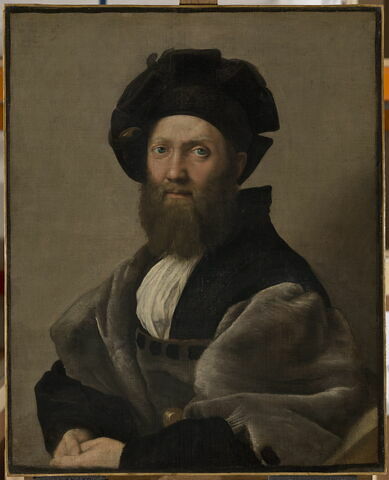
Portrait of Baldassare Castiglione

Raphael

© 2022 GrandPalaisRmn (musée du Louvre) / Michel Urtado

Why it matters / what to look for

Why it matters. The Louvre record traces this portrait from Castiglione’s family through major seventeenth-century collections to Louis XIV. That unusually early ownership history securely connects the diplomat’s likeness to its first viewers.

Good to know. After remaining with the sitter’s descendants, the portrait passed through the Mazarin collection and was acquired for Louis XIV in 1665.

B · Paintings · Denon · Salle 710

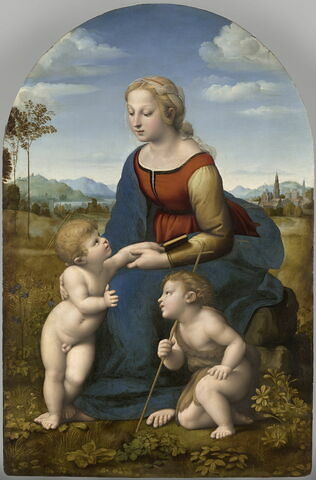
La Belle Jardinière

Raphael

© 2020 GrandPalaisRmn (musée du Louvre) / Tony Querrec

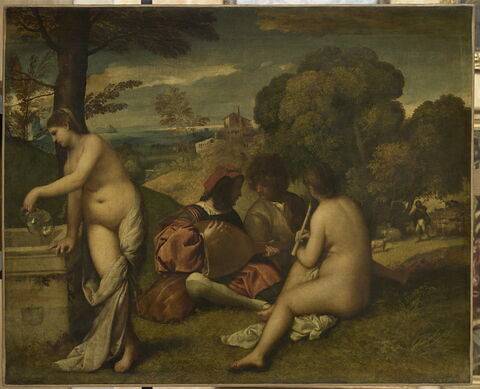
B · Paintings

Pastoral Concert

Titian / Giorgione

© 2016 GrandPalaisRmn (musée du Louvre) / Michel Urtado

Why it matters / what to look for

Why it matters. The record documents how this Venetian painting moved from a probable English collection into Louis XIV’s holdings. Its changing historical labels—Giorgione in early inventories, Titian today—also preserve a history of attribution.

Good to know. Louis XIV acquired the canvas from Everhard Jabach in 1671; the royal inventory of 1683 listed it as a work by Giorgione.

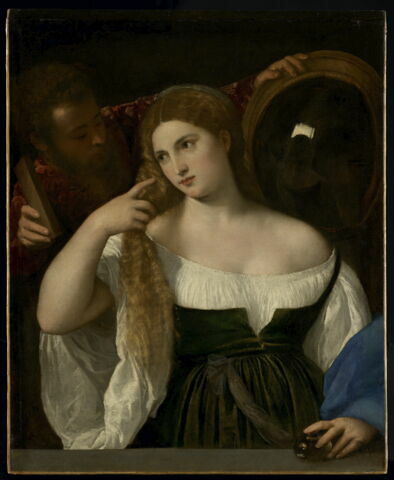
B · Paintings · Denon · Salle 711

Woman with a Mirror

Titian

© 2024 GrandPalaisRmn (musée du Louvre) / Adrien Didierjean

Why it matters / what to look for

Why it matters. This painting’s early records show how attribution shifted as it passed through princely and royal collections. It was associated with Parmigianino and Giorgione before entering the present Louvre catalogue under Titian.

Good to know. After Charles I’s collection was dispersed, the canvas passed through Everhard Jabach and was acquired by Louis XIV in 1662.

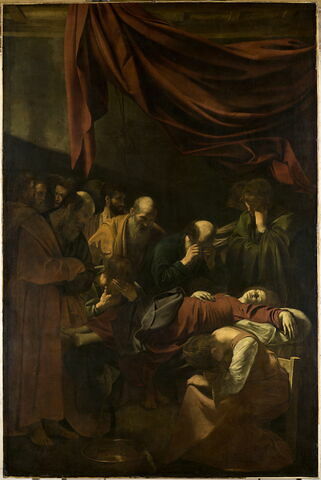
B · Paintings · Denon · Salle 712

Death of the Virgin

Caravaggio

© 2018 GrandPalaisRmn (musée du Louvre) / Mathieu Rabeau

Why it matters / what to look for

Why it matters. Commissioned for a Roman church and then rejected by its clergy, the painting became a coveted collection piece almost immediately. Its early journey from Rome to Mantua and London records that reversal.

Good to know. Laerzio Cherubini commissioned the work in 1601 for Santa Maria della Scala; after its rejection in 1605–06, the Duke of Mantua acquired it in 1607.

B · Paintings · Denon · Salle 712

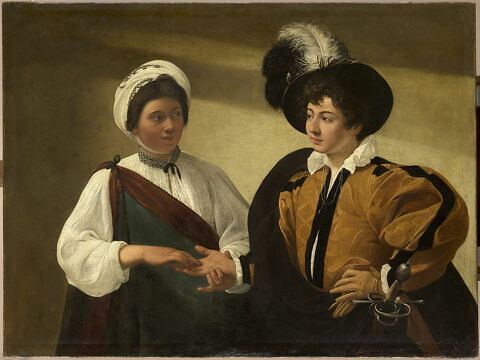
The Fortune Teller

Caravaggio

© 2018 GrandPalaisRmn (musée du Louvre) / Mathieu Rabeau

Why it matters / what to look for

Why it matters. The Louvre record places this scene within Caravaggio’s repeated exploration of the same subject: another closely related composition survives in Rome. Its royal provenance began with a diplomatic gift rather than a purchase.

Good to know. Prince Camillo Pamphili gave the painting to Louis XIV in 1665 after it had belonged to Roman collections.

B · Paintings · Richelieu · Salle 837

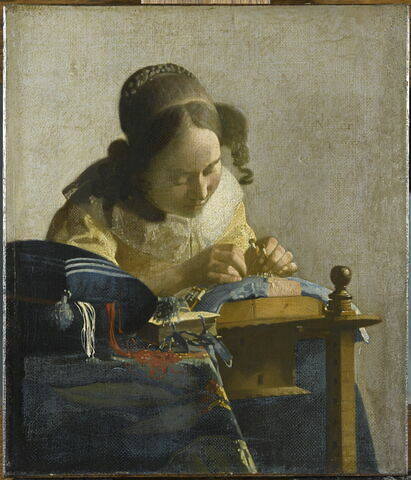
The Lacemaker

Johannes Vermeer

© 2007 GrandPalaisRmn (musée du Louvre) / Gérard Blot

Why it matters / what to look for

Why it matters. Vermeer turns domestic needlework into an experiment in focus. Blurred threads and a sewing cushion occupy the near foreground, while the woman’s hands and tools sharpen just beyond them.

  • The hands: Look at the working area where fingers, bobbins and thread converge. The small zone of precision directs attention to concentration rather than narrative action.
  • The loose threads: At the lower left, coloured threads spill from the sewing cushion and blur at close range, making the foreground feel nearer than the sharply rendered work.
  • The book: On the right lies what may be a small Bible or prayer book, linking the traditional image of lace-making with domestic virtue.
  • The light: Light arrives from the right, an unusual direction in Vermeer’s paintings, and passes gently across the figure and work table.

Good to know. The sitter was probably a socially privileged woman at home, not a professional lacemaker; there is no evidence that she was Vermeer’s wife.

B · Paintings · Richelieu · Salle 837

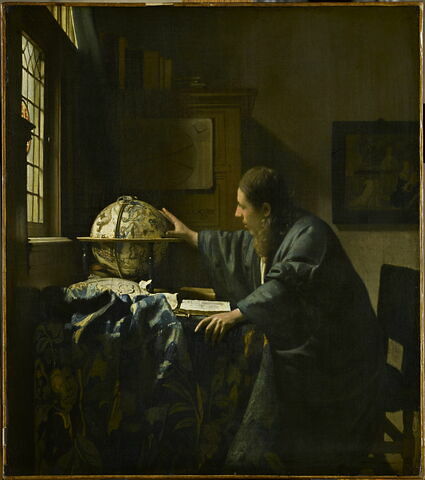
The Astronomer

Johannes Vermeer

© 2016 GrandPalaisRmn (musée du Louvre) / Franck Raux

Why it matters / what to look for

Why it matters. Vermeer builds the scholar’s activity from identifiable instruments and books rather than vague symbols. A celestial globe, an astronomy manual, compasses and an astrolabe make thought visible as careful observation.

  • The globe: The scholar reaches toward Jodocus Hondius’s celestial globe of 1600, making the mapped heavens the physical centre of his attention.
  • The open book: Metius’s 1621 astronomy manual lies open to a chapter on stars, beside an illustration of the author’s wheel astrolabe.
  • The instruments: Compare the compasses and sixteenth-century astrolabe with the globe and book; practical tools balance written and mapped knowledge.
  • The background painting: Behind the scholar, a picture of Moses rescued from the water may introduce divine providence as a counterpoint to human study.

Good to know. The sitter has sometimes been called Antoni van Leeuwenhoek, but the Louvre record stresses that this identification lacks evidence.

B · Paintings · Richelieu · Salle 818

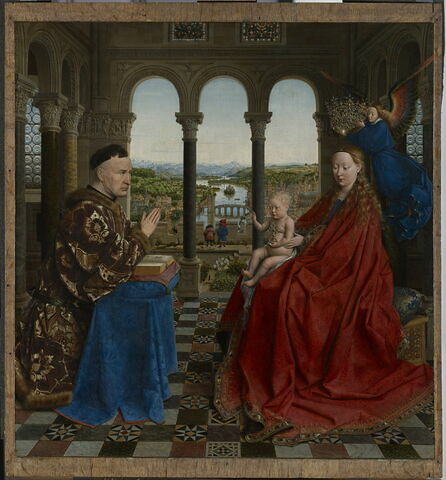
Madonna of Chancellor Rolin

Jan van Eyck

© 2023 GrandPalaisRmn (musée du Louvre) / Michel Urtado

Why it matters / what to look for

Why it matters. Van Eyck places a powerful donor face to face with the enthroned Virgin, then opens their chamber onto a minutely invented world. Devotion, status and landscape occupy one continuous, precisely observed space.

  • The encounter: Rolin kneels opposite the Virgin at equal height, his brocade robe answering her jewel-edged red mantle across the tiled interior.
  • The capitals: Look above the varied marble columns for tiny Old Testament scenes carved into some capitals, inserting earlier sacred history into the room.
  • The garden: Between the arcades and city, flowers, magpies, peacocks and two leaning figures fill a narrow garden with details that reward close viewing.
  • The city and distance: Follow the river through the bridge and island castle, then beyond mills and vineyards to snowy mountains; detail gradually yields to distance.

Good to know. Nicolas Rolin probably commissioned the panel around 1430, perhaps for private prayer and later memorial use; its exact original function remains uncertain.

B · Paintings · Richelieu · Salle 814

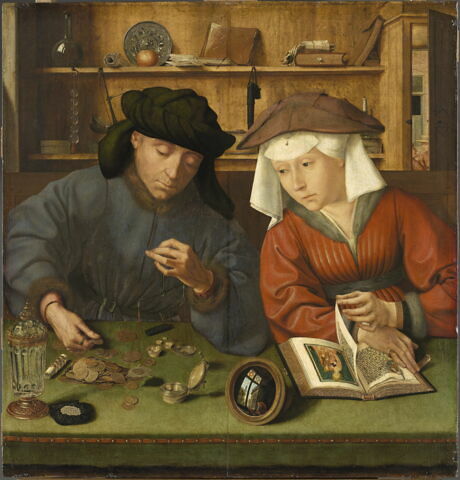
The Money Changer and His Wife

Quentin Massys

© 2014 GrandPalaisRmn (musée du Louvre) / Tony Querrec

Why it matters / what to look for

Why it matters. The Louvre record is unusually valuable for the painting’s seventeenth-century reputation: owners and sale catalogues already described it in detail and repeatedly associated it with Quentin Massys.

Good to know. After circulating among Antwerp merchants and collectors, the panel was bought for the Louvre at a Paris sale in 1806.

B · Paintings · Denon · Salle 710

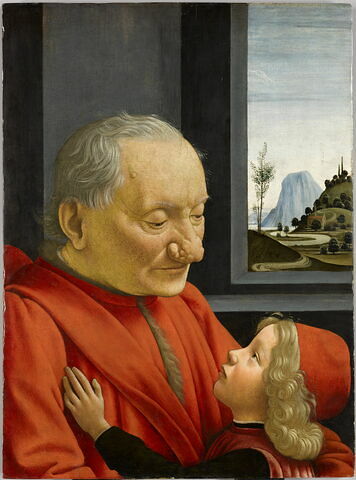
An Old Man and His Grandson

Domenico Ghirlandaio

© 2017 GrandPalaisRmn (musée du Louvre) / Franck Raux

B · Paintings · Denon · Salle 708

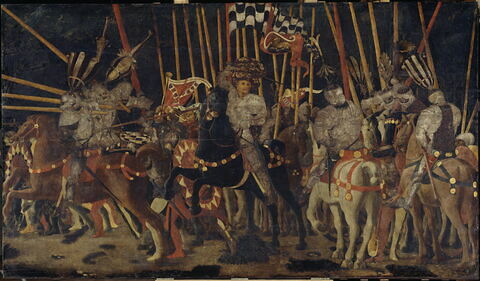
The Battle of San Romano

Paolo Uccello

© 1997 GrandPalaisRmn (musée du Louvre) / Jean-Gilles Berizzi

Why it matters / what to look for

Why it matters. This panel belongs to a three-part cycle made for a Florentine palace, so the battle originally unfolded around a room rather than within one frame. Later alterations reshaped that architectural relationship.

Good to know. Originally shaped to fit a room, the panel was probably cut into a rectangle in 1484; its two companions are now in London and Florence.

B · Paintings · Denon · Salle 708

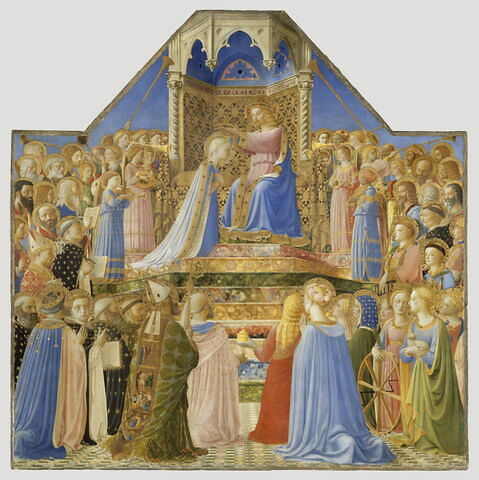
The Coronation of the Virgin

Fra Angelico

© 2001 GrandPalaisRmn (musée du Louvre) / Gérard Blot/Hervé Lewandowski

Why it matters / what to look for

Why it matters. The surviving panel combines the principal sacred image with a predella that unfolds episodes from Saint Dominic’s life. Its original mitre-shaped top and narrative base still reveal the architecture of a larger altarpiece.

  • The upper outline: Follow the original mitre-shaped edge at the top. The pointed silhouette belonged to the altarpiece’s design rather than a later reshaping.
  • The predella: Along the base, read the small scenes from left to right: visions, miracles, debate, angelic service and Dominic’s death form a compact narrative sequence.

Good to know. The altarpiece was probably painted for San Domenico in Fiesole before 1435 and remained there until it was removed to the Louvre in 1812.

B · Paintings · Denon · Salle 702

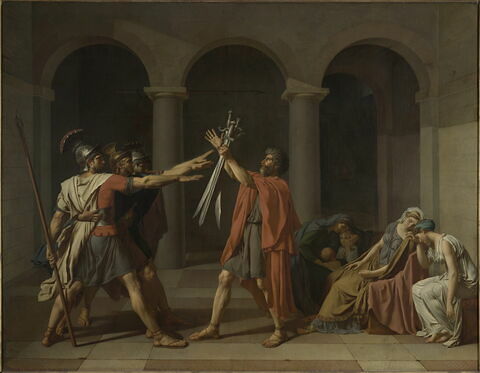
Oath of the Horatii

Jacques-Louis David

© 2018 GrandPalaisRmn (musée du Louvre) / Michel Urtado

Why it matters / what to look for

Why it matters. A royal commission changed substantially in David’s hands: he replaced the planned subject, enlarged the canvas and painted it in Rome. The work therefore records an artist reshaping official history painting.

Good to know. Commissioned by Louis XVI’s administration in 1781–82, the painting was completed in Rome in 1785 and shown there before reaching the Paris Salon.

B · Paintings · Denon · Salle 700

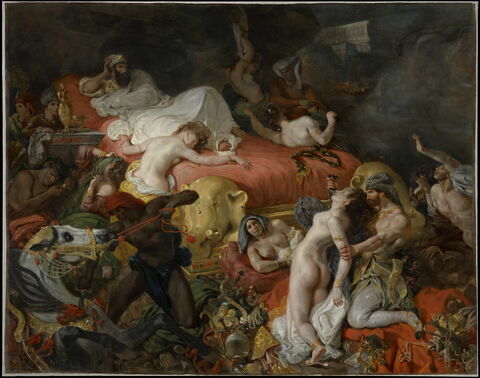
Death of Sardanapalus

Eugène Delacroix

© 2023 GrandPalaisRmn (musée du Louvre) / Michel Urtado

Why it matters / what to look for

Why it matters. Delacroix takes a ruler’s final command and expands it across a canvas almost five metres wide. The subject joins luxury and destruction: everything associated with Sardanapalus’s pleasures must die with him.

  • Sardanapalus: At the top of the immense pyre, the ruler reclines on a sumptuous bed and directs the destruction rather than joining the struggle below.
  • The victims: Across the scene, officers and eunuchs kill women, pages, horses and dogs, turning individual bodies into the consequences of a single order.
  • The pyre: Trace the structure beneath the bed: the palace’s riches and living beings have been gathered into one construction intended for burning.

Good to know. Shown at the 1828 Salon, the unsold canvas remained with Delacroix for eighteen years and did not enter the Louvre until 1921.

B · Paintings · Denon · Salle 702

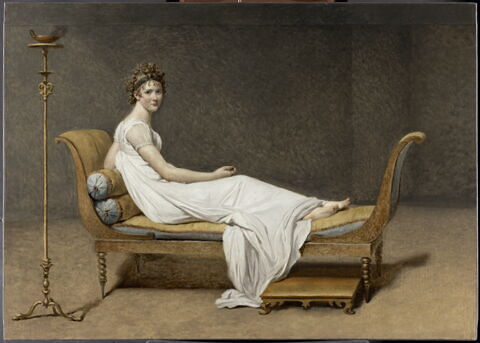
Portrait of Madame Récamier

Jacques-Louis David

© 2025 GrandPalaisRmn (musée du Louvre) / Didierjean/Chan-Liat

Why it matters / what to look for

Why it matters. David leaves the portrait visibly unfinished, yet its spare antique setting, white dress and expansive horizontal format already create an image of controlled elegance. The incomplete surface makes the composition itself easier to see.

  • The turn of the head: Madame Récamier sits sideways on the daybed but turns her three-quarter face toward you, balancing informality with direct presence.
  • The white dress: Her simple pale clothing stands out against the long antique-style couch, concentrating attention on pose rather than ornament.
  • The unfinished paint: Move closer to compare more developed passages with broad, unresolved areas. The visible incompletion exposes David’s process of establishing form and balance.

Good to know. Commissioned by Juliette Récamier and her husband in 1800, the portrait remained unfinished and stayed in David’s possession until his death in 1825.

C · Paintings · Sully · Salle 912

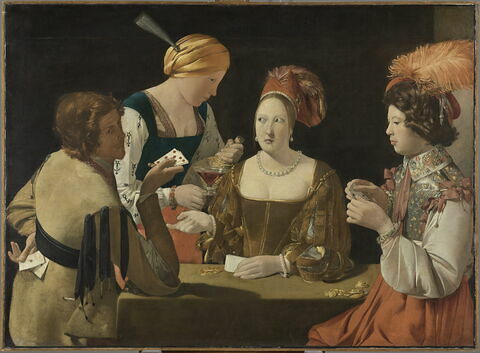
The Cheat with the Ace of Diamonds

Georges de La Tour

© 2016 GrandPalaisRmn (musée du Louvre) / Adrien Didierjean

Why it matters / what to look for

Why it matters. La Tour makes deception legible through a precise exchange of glances and gestures. Four figures form a shallow frieze, yet subtle symmetries separate the richly dressed victim from the coordinated group cheating him.

  • The hidden card: At the left, the player reaches behind his back for the ace of diamonds while turning his face toward the others, exposing the trick to us.
  • The glances: Follow the eyes between the cheat, servant and woman. Their sideways looks organize a silent conversation from which the young victim is excluded.
  • The victim: On the right, excessive finery announces the adolescent’s vanity while the gap around him isolates his credulity from the compact group.
  • The colour: Compare smooth luminous flesh with the restricted, grave palette; the stronger chiaroscuro anticipates La Tour’s later nocturnal paintings.

Good to know. Scientific imaging shows that La Tour revised an earlier version: he changed the servant’s position and repainted her bodice from red to dark blue-green.

C · Paintings · Sully · Salle 917

Pilgrimage to the Isle of Cythera

Antoine Watteau

© 2010 GrandPalaisRmn (musée du Louvre) / Stéphane Maréchalle

Why it matters / what to look for

Why it matters. Watteau submitted this painting as his reception piece to the Royal Academy in 1717. Its institutional role is unusually clear: it entered the Academy’s collection and remained on view at the Louvre throughout the eighteenth century.

Good to know. Seized with the Royal Academy’s collection in 1795, the canvas had already been displayed in the Academy’s Louvre meeting room for decades.

C · Paintings · Sully · Salle 929

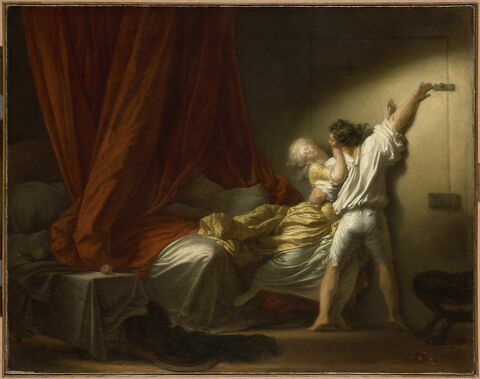
The Bolt

Jean-Honoré Fragonard

© 2020 GrandPalaisRmn (musée du Louvre) / Michel Urtado

Why it matters / what to look for

Why it matters. Fragonard conceived this painting as a pendant to an Adoration of the Shepherds. The pairing deliberately opposed profane and sacred love, making the work’s original meaning depend on another canvas.

Good to know. Painted for the Marquis de Véri around 1777–78, the work remained in private collections until the Louvre acquired it in 1974.

C · Paintings · Richelieu · Salle 824

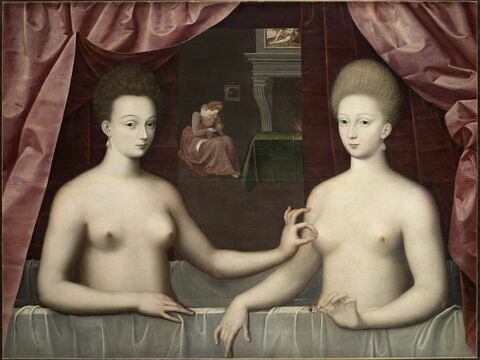
Gabrielle d'Estrées and One of Her Sisters

School of Fontainebleau

© 2017 GrandPalaisRmn (musée du Louvre) / Tony Querrec

Why it matters / what to look for

Why it matters. The Louvre record identifies the composition as a courtly allegory rather than a straightforward double portrait. Numerous surviving versions connect its enigmatic pairing to the birth of one of Henry IV’s children.

Good to know. Gabrielle’s companion may be the Duchess of Villars or the Maréchale de Balagny; the Louvre record does not settle the identification.

C · Paintings · Richelieu · Salle 844

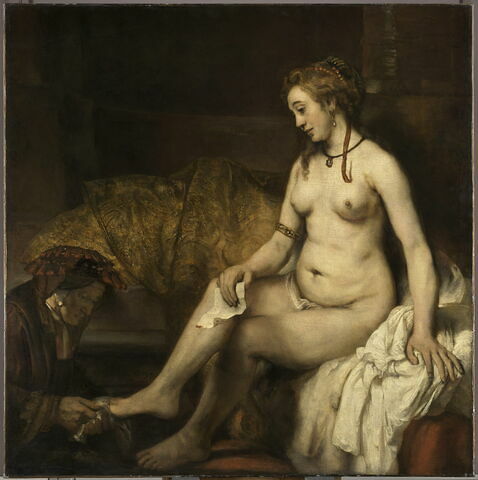
Bathsheba at Her Bath

Rembrandt

© 2015 GrandPalaisRmn (musée du Louvre) / Mathieu Rabeau

Why it matters / what to look for

Why it matters. Rembrandt removes King David from the biblical scene and concentrates the moral crisis in Bathsheba’s body and the letter she holds. Narrative spectacle gives way to a private moment of decision.

  • The letter: Bathsheba holds David’s message, the object that makes an otherwise quiet bathing scene the turning point of the biblical story.
  • The lowered head: Her inclined head directs attention inward rather than toward an absent messenger or king; radiography shows that Rembrandt first planned it less deeply bowed.
  • David’s absence: Look across the surrounding space for the king and notice that he never appears. His unseen demand is present only through the letter.

Good to know. The figure is often said to have been modelled by Hendrickje Stoffels, but the Louvre record presents this as a frequent belief, not a certainty.

C · Sculpture · Salle 001

Rebellious Slave

Michelangelo

© 2022 Musée du Louvre, Dist. GrandPalaisRmn / Hervé Lewandowski

Why it matters / what to look for

Why it matters. Michelangelo carved this figure in 1513–15 for the lower level of Julius II’s tomb. Its later exclusion preserves a major abandoned element from a funerary project repeatedly reduced and redesigned.

Good to know. Michelangelo gave the unused sculpture to Roberto Strozzi in 1546; it soon reached France and entered the Louvre in 1794.

C · Ancient sculpture · Sully · Salle 348

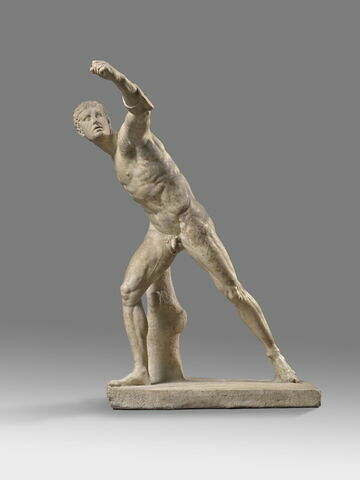
Borghese Gladiator

Ancient Greece

© 2017 Musée du Louvre, Dist. GrandPalaisRmn / Hervé Lewandowski

Why it matters / what to look for

Why it matters. Agasias carved the nearly life-size fighter from a single block of Pentelic marble. The extended combat pose was designed around weapons now missing, so the surviving body still records an absent sword and shield.

  • The diagonal body: Follow the warrior from the driving legs through the angled torso toward the extended arms; the whole anatomy is organized for combat rather than rest.
  • The empty hands: Reconstruct the missing sword and shield from the arm positions. Their absence makes the figure’s defensive and attacking directions easier to isolate.
  • The tree support: At the lower body, the carved tree trunk stabilizes the long marble extension while remaining secondary to the fighter’s movement.

Good to know. Found at ancient Antium, the statue has extensive restorations, including a remade right arm and rejoined limbs; the Louvre acquired it in 1807.

C · Ancient sculpture · Sully · Salle 348

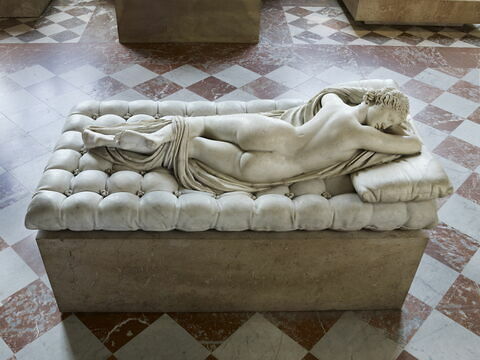
Sleeping Hermaphroditus

Antiquity / Gian Lorenzo Bernini

© 2011 Musée du Louvre, Dist. GrandPalaisRmn / Thierry Ollivier

Why it matters / what to look for

Why it matters. An ancient marble figure and a seventeenth-century bed form one deliberately unified object. Bernini’s mattress and pillow, added in 1620, turn the sleeper’s pose into an encounter between Roman sculpture and Baroque illusion.

  • The first view: From the back, braided hair, bare shoulders and the sleeping curve of the body establish a calm reclining figure before its identity becomes clear.
  • The opposite side: Walk around the bed: the frontal view reveals the combined sexual anatomy signalled by the title, changing the reading established from behind.
  • The mattress: Compare the ancient body with Bernini’s deeply pressed marble bedding. The apparently soft pillow and mattress were carved and attached in 1620.

Good to know. Discovered in Rome in 1618, the ancient figure received Bernini’s mattress and pillow in 1620 and was acquired for France in 1807.

C · Ancient sculpture · Sully · Salle 348

Diana of Versailles

Ancient Rome after Greek original

© 2011 Musée du Louvre, Dist. GrandPalaisRmn / Thierry Ollivier

Why it matters / what to look for

Why it matters. This Roman marble presents Artemis in rapid movement rather than static display. Short garments, turning drapery and the remains of a deer build the image of a huntress advancing through space.

  • The stride: Follow the forward leg and running body: the goddess’s weight shifts through the figure instead of settling evenly on both feet.
  • The clothing: The short chiton and wrapped himation leave the legs free while their folds carry the direction of the movement.
  • The quiver and deer: Look behind and beside the goddess for the quiver and surviving parts of the deer, attributes that define the moving figure as Artemis the huntress.
  • The hair: The wavy hair is gathered into a chignon beneath a diadem; drilled channels create sharper shadows than the smoother face.

Good to know. Much of the statue was restored in 1602 and 1808, including both arms, part of one leg, the quiver and most of the deer.

C · Sculpture · Richelieu · Salle 105

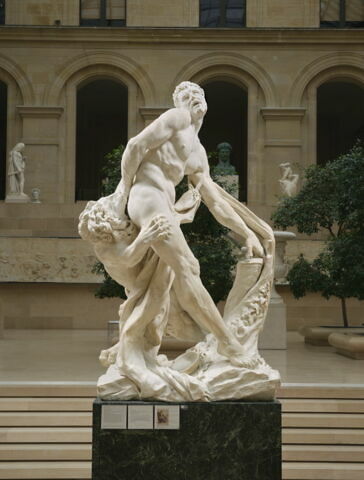
Milo of Croton

Pierre Puget

© 2024 Musée du Louvre, Dist. GrandPalaisRmn / Thierry Ollivier

Why it matters / what to look for

Why it matters. The work’s documented making reveals the scale of royal sculpture under Louis XIV: Colbert supplied the marble, the king approved Puget’s design, and completion required years of work and transport.

Good to know. Completed in Marseille in 1682, the sculpture was unveiled on the Royal Walk at Versailles in 1683 and entered the Louvre in 1819.

C · Near East · Richelieu · Salle 234

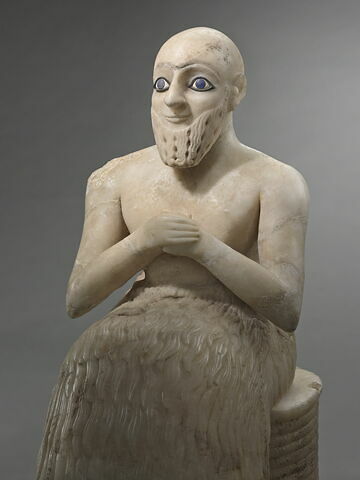
Statue of Ebih-Il

Mari, Syria

© 2014 Musée du Louvre, Dist. GrandPalaisRmn / Raphaël Chipault

Why it matters / what to look for

Why it matters. Alabaster, shell, lapis lazuli and bitumen concentrate attention on Ebih-Il’s clasped hands and inlaid eyes. The compact seated figure turns costly material into a permanent attitude of prayer.

  • The eyes: Shell and lapis lazuli form the inlaid eyes, once accompanied by similarly inlaid brows and beard, making the gaze the figure’s brightest feature.
  • The hands: The steward holds both hands together at the chest, a compact gesture that identifies the statue as a worshipper.
  • The skirt: Look at the textured kaunakes skirt above the woven stool; carved pattern distinguishes clothing and furniture from the smoother body.

Good to know. The inscribed statue was discovered on 23 January 1934 in the courtyard of the Temple of Ishtar at Mari and divided after excavation.

C · Near East · Richelieu · Salle 228

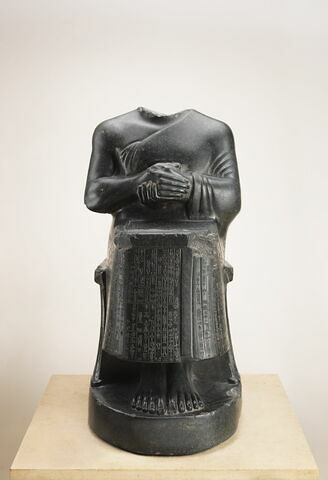
Gudea the Architect

Sumer

© 2011 Musée du Louvre, Dist. GrandPalaisRmn / Philippe Fuzeau

Why it matters / what to look for

Why it matters. Gudea appears as both worshipper and builder: clasped hands signal devotion, while a plan, stylus and graduated rule rest on his lap. Rulership is expressed through measured construction rather than military force.

  • The plan: On the tablet across Gudea’s knees, a building plan turns the seated statue into a specific image of architectural preparation.
  • The tools: Beside the plan lie a stylus and graduated rule, compact signs of drawing, calculation and controlled measurement.
  • The hands: Above the tablet, the prince’s clasped hands retain the conventional gesture of prayer, joining technical authority to devotion.
  • The diorite: Follow the dense dark stone across the broad robe and compact body; the hard material gives the seated form visual weight.

Good to know. Dedicated to the god Ningirsu, the incomplete statue was excavated at Tello between 1877 and 1881 and acquired after the excavations.

C · Near East · Richelieu · Salle 229

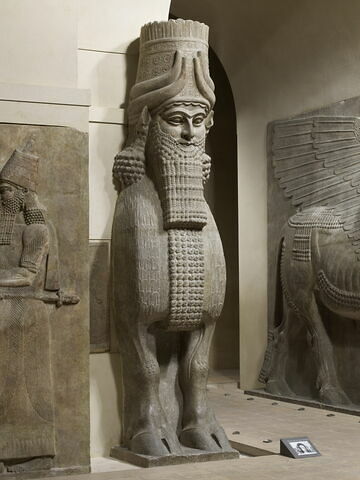
Winged Human-Headed Bull from Khorsabad

Assyria

© 2011 Musée du Louvre, Dist. GrandPalaisRmn / Thierry Ollivier

Why it matters / what to look for

Why it matters. The lamassu combines a crowned human head, bull’s body and wings into a monumental guardian. Five legs solve a viewing problem: it appears still from the front and striding from the side.

  • The five legs: Count the limbs from different angles. Two establish a stable frontal stance, while four visible in profile create a walking bull.
  • The head: A horned tiara and pendant earrings give the human face ceremonial authority above the massive animal body.
  • The wings: Follow the layered feathers backward from the shoulder; their large pattern balances the scale of the bull’s chest and legs.
  • The inscriptions: One text runs between the legs and another covers the reverse, joining written royal presence to the guardian image.

Good to know. Excavated at Sargon II’s capital, Khorsabad, in 1843–44, the relief was cut into six slabs for transport and reached the Louvre in 1847.

C · Islamic art

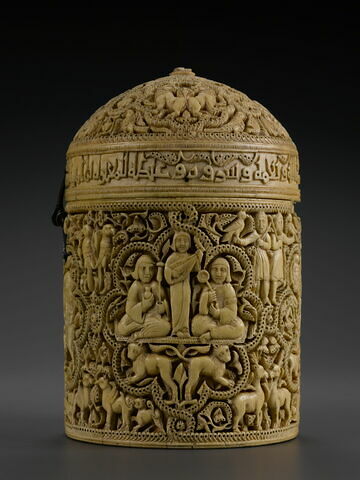
Pyxis of al-Mughira

Umayyad Spain

© 2009 Musée du Louvre, Dist. GrandPalaisRmn / Hughes Dubois

Why it matters / what to look for

Why it matters. The dated ivory box anchors Umayyad court craftsmanship to a precise place and year: Madinat al-Zahra in 968. Its carved and engraved elephant ivory makes a small container into a prestigious court object.

Good to know. An inscription dates the pyxis to 357 AH, equivalent to 968, and names al-Mughira; the Louvre acquired it in 1898.

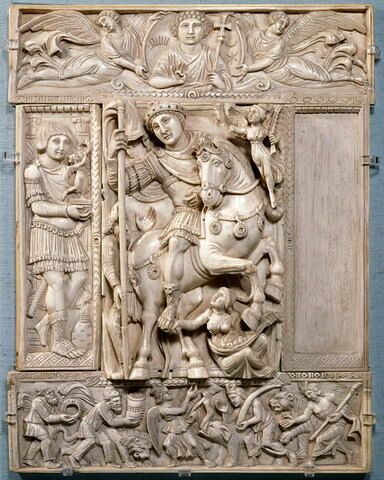
C · Decorative arts · Richelieu · Salle 501

Barberini Ivory

Byzantium

© 1986 GrandPalaisRmn (musée du Louvre) / Maurice et Pierre Chuzeville

Why it matters / what to look for

Why it matters. This is the only nearly complete surviving leaf from a five-part imperial ivory diptych. Its stacked reliefs unite military victory, conquered peoples and Christ’s blessing into one image of Byzantine rule.
  • The emperor: At the centre, the mounted ruler drives a spear into the ground while a bearded captive is held beside it, making conquest the composition’s core.
  • The Earth: Beneath the horse, a female personification grasps the emperor’s foot in submission, placing the land itself under his authority.
  • Christ and the Victories: Above the rider, Christ blesses between winged Victories; a soldier at left offers another Victory statuette with a laurel crown.
  • The tribute: Along the bottom, conquered peoples approach with tribute, extending the triumph from a single captive to entire populations.

Good to know. The emperor is probably Justinian, but the identification is not certain; one of the five original ivory plaques is now missing.

Quick answer

Most visitors keep good concentration for about 2–3 hours. A longer visit works better with a break and a shorter must-see list.